


Keywords
Didelphis marsupialis
Didelphis pernigra
mandibular heterochrony
mandibular isometry
mandibular shape
How to Cite
Abstract
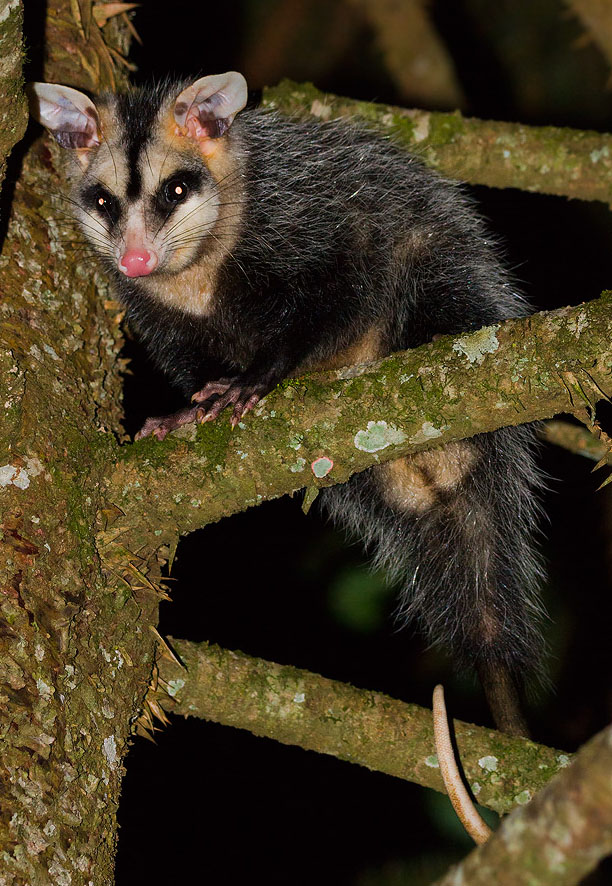
In this study, the size and shape of the jaw were analyzed in three species of opossum (Didelphis sp.) from Colombia, using 2D geometric morphometry techniques. For this, the lateral plane of 139 hemimandibles of Didelphis albiventris n=20 (13 males + 7 females), D. marsupialis n=82 (41 males + 41 females), and D. pernigra n=37 (14 males + 23 females) from 17 reference points of the left hemimandible. All jaws were complete and came from non-lactating specimens. No sexual dimorphism was observed in size and shape. An isometric growth was found in the three species, which suggests that the mandible has a similar function in the three species from weaning onwards, possibly due to having identical feeding habits, despite the body differences between the three species, the mandible has maintained a similar form.
References
Abdala, F., D.A. Flores y N.P. Giannini. 2001. Postweaning ontogeny of the skull of Didelphis albiventris. Journal of Mammalogy, 82:190-200.
Astúa, D. 2015. Morphometrics of the largest new world marsupials, opossums of the genus Didelphis (Didelphimorphia, Didelphidae). Oecologia Australis, 19:117-142.
Astúa, D. y N.O. Leiner. 2008. Tooth eruption sequence and replacement pattern in woolly opossums, genus Caluromys (Didelphimorphia: Didelphidae). Journal of Mammalogy, 89: 244-251.
Astúa de Moraes, D. 2010. Cranial sexual dimorphism in new world marsupials and a test of Rensch’s rule in Didelphidae. Journal of Mammalogy, 91:1011-1024.
Cerqueira, R. y B. Lemos. 2000. Morphometric differentiation between Neotropical black-eared opossums, Didelphis marsupialis and D. aurita (Didelphimorphia, Didelphidae). Mammalia, 64:319-327.
Flores, D.A. 2009. Phylogenetic analyses of postcranial skeletal morphology in didelphid marsupials. Bulletin of the American Museum of Natural History, (320):1-81.
Fonseca, C.T. y J.B. Alves. 2006. Dental development of Didelphis albiventris (Marsupialia): I-Incisors and Canines. Brazilian Journal of Biology, 66:53-60.
Gardner, A.L. 2007. Marsupials, xenarthrans, shrews, and bats.” In mammals of South America. The University of Chicago Press. Chicago.
Hammer, Ø., D.A.T. Harper y P.D. Ryan. 2001. PAST v. 2.17c. Palaeontologia Electronica, 4:1-229.
Hugh Tyndale-Biscoe, C. 2005. Life of Marsupials. Ed. Csiro. Collingwood.
Klingenberg, C.P. 2011. MorphoJ: An integrated software package for geometric morphometrics. Molecular Ecology Resources, 11:353-357.
Klingenberg, C.P. 2016. Size, shape, and form: Concepts of allometry in geometric morphometrics. Development Genes and Evolution, 226:113-137. http://dx.doi.org/10.1007/s00427-016-0539-2.
Lopez Galan, A. 2016. Morfometría geométrica: El estudio de la forma y su aplicación en Biología. Temas de Ciencia y Tecnología, 19:53-59.
Moraes, D.A. de, E. Hingst-Zaher, L.F. Marcus R. Cerqueira. 2000. A geometric morphometric analysis of cranial and mandibular shape variation of Didelphis marsupialis. Hystrix, 10:115-130.
Nummela, S. y M.R. Sánchez-Villagra. 2006. Scaling of the marsupial middle ear and its functional significance. Journal of Zoology, 270:256-267.
Pélabon, C. et al. 2014. Evolution of morphological allometry. Annals of the New York Academy of Sciences, 1320:58-75.
Richtsmeier, J.T., V.B. DeLeon y S.R. Lele. 2002. The promise of geometric morphometrics. Yearbook of Physical Anthropology, 45:63-91.
Rohlf, F.J. 2010. Digitalized landmarks and outlines. New York: Stony Brook: Department of Ecology and Evolution, State University of New York.
Schimming, B.C. et al. 2016. Anatomical and radiographic study of the white-eared opossum (Didelphis albiventris) skull.” Pesq. Vet. Bras., 36:1132-1138.
Sebastião, H. y G. Marroig. 2013. Size and shape in cranial evolution of 2 marsupial genera: Didelphis and Philander (Didelphimorphia, Didelphidae) Squirrels (Saimiri) Monkeys (Cebinae, Platyrrhini). Journal of Mammalogy, 94:1424-1437. http://www.bioone.org/doi/abs/10.1644/11-MAMM-A-349.1.
Smith, K.K. 2006. Craniofacial development in marsupial mammals: Developmental origins of evolutionary change. Developmental Dynamics, 235:1181-1193.
Swiderski, D.L. 2003. Separating size from allometry: Analysis of lower jaw morphology in the fox squirrel, Sciurus niger. Journal of Mammalian Evolution, 84:861-876.
Ventura, J., M. Salazar, R. Pérez-Hernández y M.J. López-Fuster. 2002. Morphometrics of the genus Didelphis (Didelphimorphia: Didelphidae) in Venezuela. Journal of Mammalogy, 83:1087-1096.
Webster, M. y H.D. Sheets. 2010. A practical introduction to landmark-based geometric morphometrics. Pp. 163-188, en: Quantitative methods in Paleobiology (J. Alroy y G. Hunt., eds.) Chicago: The Paleontological Society.
Weisbecker, V. y M. Nilsson. 2008. Integration, heterochrony, and adaptation in pedal digits of syndactylous marsupials. BMC Evolutionary Biology, 8:160.

This work is licensed under a Creative Commons Attribution-NonCommercial-NoDerivatives 4.0 International License.
Copyright (c) 2024 UNIVERSIDAD NACIONAL AUTÓNOMA DE MÉXICO